Two Camps of Brokers: Price and Win vs. Operate Scared
Brokers who quote first and then go get the truck keep growing. Brokers who wait for a truck before they quote stay small.

I keep having the same conversation with brokers, and I've started to notice which way it goes before they've finished their first sentence.
Somewhere in the first few minutes of a coaching call, I ask how they handle a new quote request. How they answer tells me a lot about where their business is headed.
Some brokers say, "I give them a rate, and if we win it, we go find the truck."
Others say, "I don't quote until I've got a truck lined up."
I hear a version of the second answer from our own customers too. "I need to find a truck first, so I'll post it on Cargado and see what comes back." Honestly, I love that they rely on Cargado to find capacity.
But think about where that load is going. If you're quoting freight out of a market with plenty of capacity, where carriers are bidding hard on everything that gets posted, every other broker posting freight there can cover it too. Waiting on a truck before you quote that load just makes you slower than them.
If the freight is easy to cover, go price it and win it. I want brokers using Cargado to price freight just as much as I want them using it to post freight. Get the freight, cover it, and keep moving.
You don't need to price everything scared.
The two camps
I think of them as two camps.
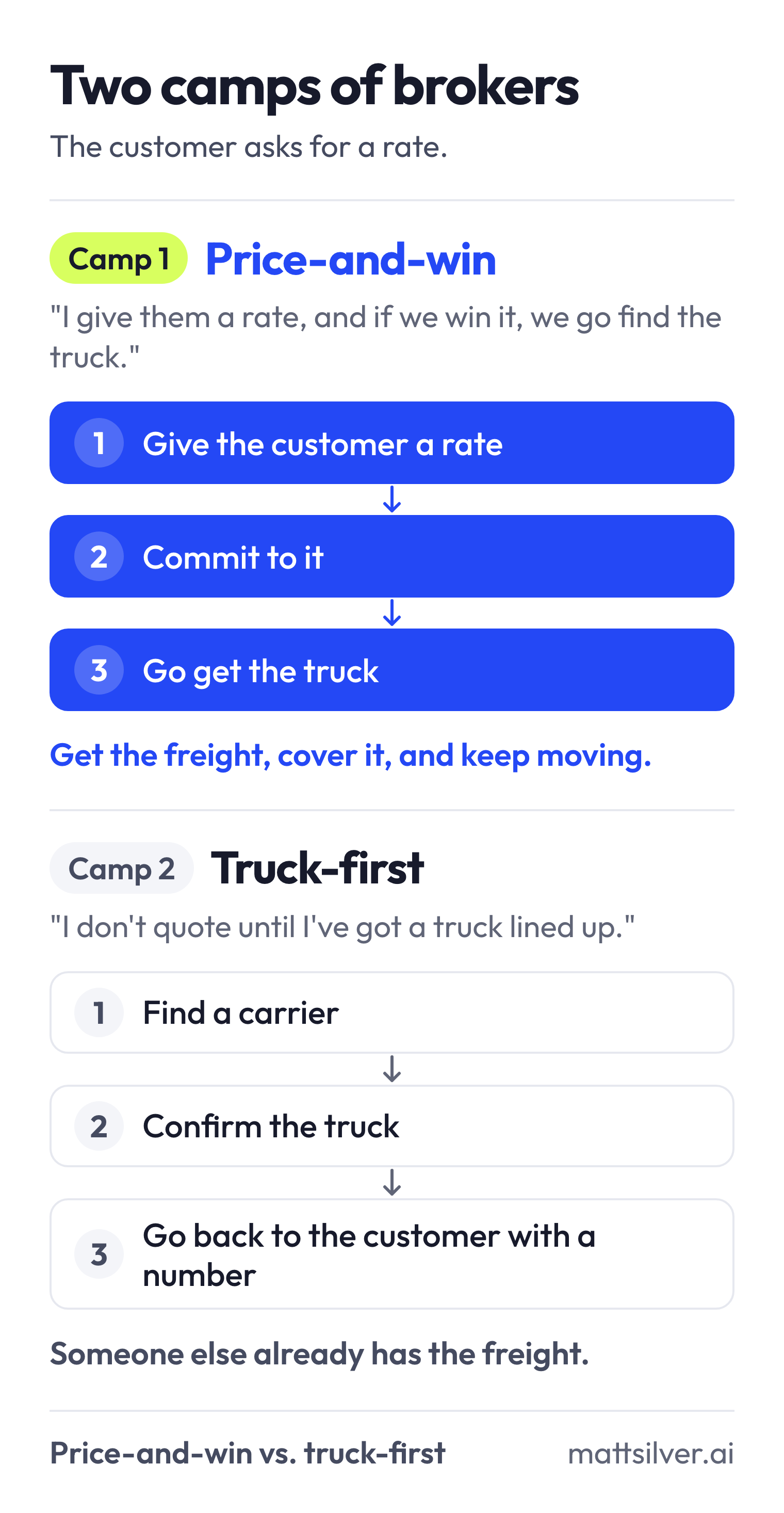
Camp 1 is price-and-win. The customer asks for a rate. The broker gives one, commits to it, and then goes and gets a truck.
Camp 2 is truck-first. The customer asks for a rate. The broker goes and finds a carrier first, confirms the truck, and only then goes back to the customer with a number.
I'll be upfront about where I stand. I was raised to price to win.
I want to be fair to truck-first, because I understand it. A lot of you were trained that way. Somebody senior told you early on, "Never promise what you can't cover." You probably got burned once or twice on a load where you quoted tight, the market moved, and you ate it. That stings. It sticks with you.
So you built a habit that protects you from that feeling. Truck first, then quote. It feels responsible.
But I've sat across from enough brokers to say this plainly: truck-first has a growth ceiling. And most brokers running it don't see it, because from where they're sitting it just looks like being careful.
Why truck-first keeps you small
Here's what happens when you wait for a truck before you quote.
You quote fewer loads. Finding a truck takes time and effort. If every quote requires that work up front, you can only quote as many loads as you can pre-cover. That's a much smaller number than the requests coming in.
You quote later. Even on the loads you do quote, you're slow. You're making calls, waiting on callbacks, confirming equipment. Meanwhile the customer is waiting on you.
Someone else already has the freight. By the time you come back with your number, a price-and-win broker already quoted it and the customer said yes. You did all that work to line up a truck for a load you never had a shot at.
And it compounds.
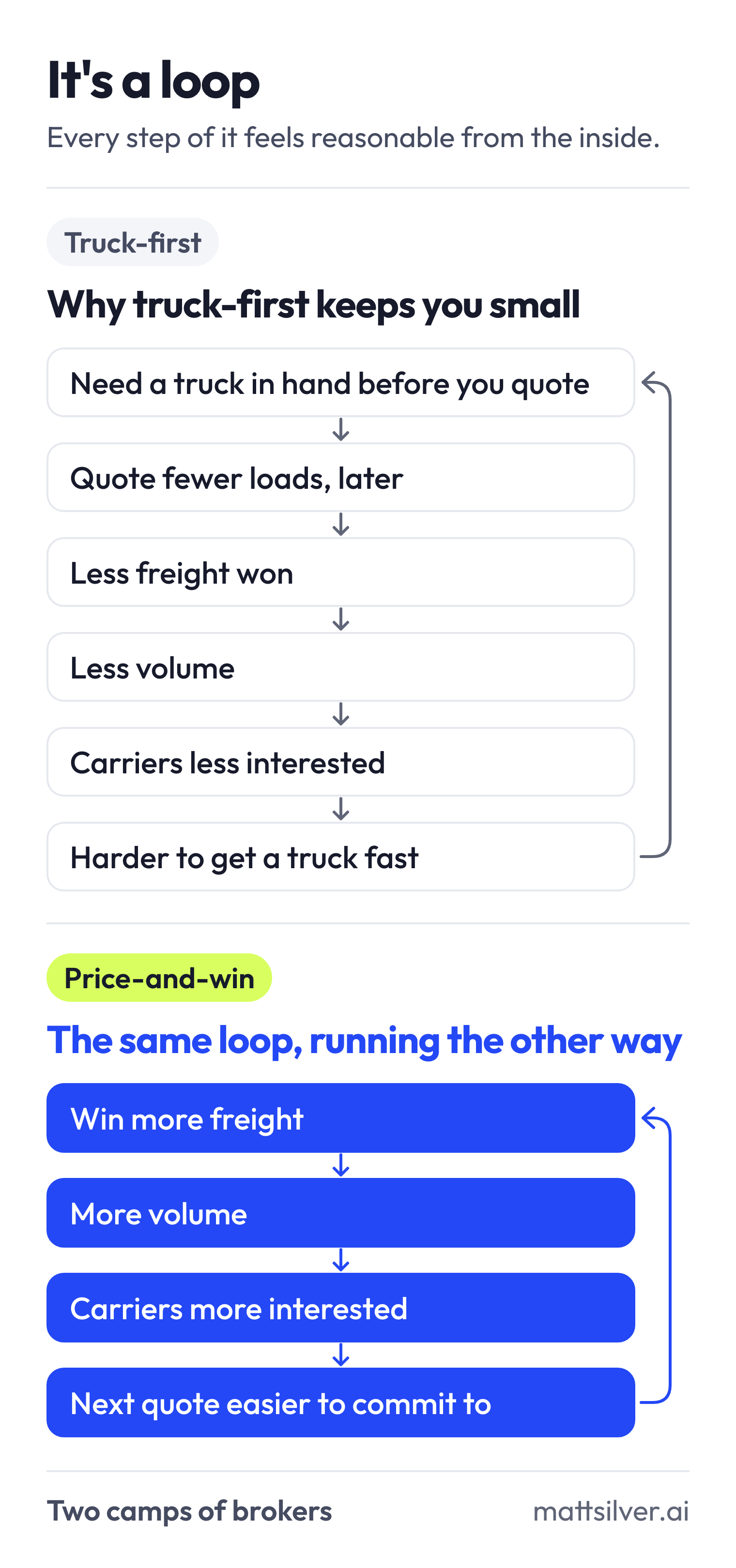
Less freight won means less volume. Less volume means you're not a very interesting broker to carriers. You can't offer them consistent lanes or repeat loads. So when you do need a truck, it's harder to get one fast.
Which makes you feel like you really need a truck in hand before you quote.
Which means you quote fewer loads, later.
It's a loop, and every step of it feels reasonable from the inside.
And there's a cost on the other side of the call. Carriers hate being asked to quote freight you don't have yet, because most of the time they won't get it. The more you ask carriers for rates and then don't give them loads, the more they start thinking, "That broker never actually sends me freight." That's what your reputation becomes. When you've got a market rate with high confidence and real data behind it, lean in. Quote your customer, win the load, and go get the truck once you actually own the freight.
What price-and-win requires
I want to be careful here, because "quote first" can sound like "throw numbers out and hope."
The good price-and-win brokers do the opposite.
To price and win, you have to know the market well enough to lock a rate you can cover. You need to know what the lane is paying. You need a feel for where capacity is tight and where it's loose. You need enough carrier relationships, and enough real pricing data, that when you commit to a number you're confident you can go get a truck at a rate that still leaves you margin.
So the risk is still there. You handle it by knowing your numbers well enough to commit, and that's a skill you can build.
Patty Hinojosa runs Mexico sales and operations at CargoQuotes and uses Cargado Market Rates every day. She put it better than I can: "It helps us quote fast, and that's when you win it. Customers ask for a rate at 11, and by 11:30 they have it."
(One quick nuance, since I know someone's going to bring it up. On a brand-new lane - especially a brand-new Mexico lane you've never run - or any lane where you don't have a rate you trust yet, it can make sense to check the market or check capacity before you send a price. That's homework, and homework is good. Checking capacity on a lane like that is a big part of why we built Potentials. Making truck-in-hand your rule for every load is the problem.)
If you're truck-first
I'm going to be direct.
Pull up your last month of quote requests. Look at how many you quoted. Then look at how long it took you to respond on the ones you did quote. Then look at how many of those you won.
If you're quoting a fraction of what comes in, you're responding hours after the request, and your win rate is low on the ones you do quote, then truck-first is what's keeping you small.
You might have avoided a few bad loads. Fair enough. But how many good loads did you never even get a shot at?
Most brokers I talk to who work this way have never done that math.
One team that did the math
Earlier this year I was on a call with the Mexico team at one of the bigger names in freight. They'd been pricing spot loads off where their own trailers were going to be. When they dug into their win rate, the answer was blunt: it wasn't working.
So they flipped it. Price off the market, book the load, then go find the capacity to back into it.
That one stuck with me. This is a company with its own trailers, and they still decided the truck couldn't come first. A ten-person brokerage can at least test it on a lane or two.
What I'd do if I were you
I wouldn't flip the whole operation overnight. That's how people get burned and run right back to their old habits.
Here's what I'd do.
- Pick one or two lanes where you have high confidence in the market rate and a thin margin of error. You don't need a long history on the lane. A lot of brokers are trying to win freight for the first time, or they're early in growing it and haven't moved much yet. That's fine, as long as you trust the number.
- On those lanes, quote first. Give the customer a rate fast. Commit to it. Then go get the truck.
- Back your number with today's market, not gut feel or what you paid three months ago.
- Track the same numbers you pulled earlier, plus how many loads you covered at the margin you expected.
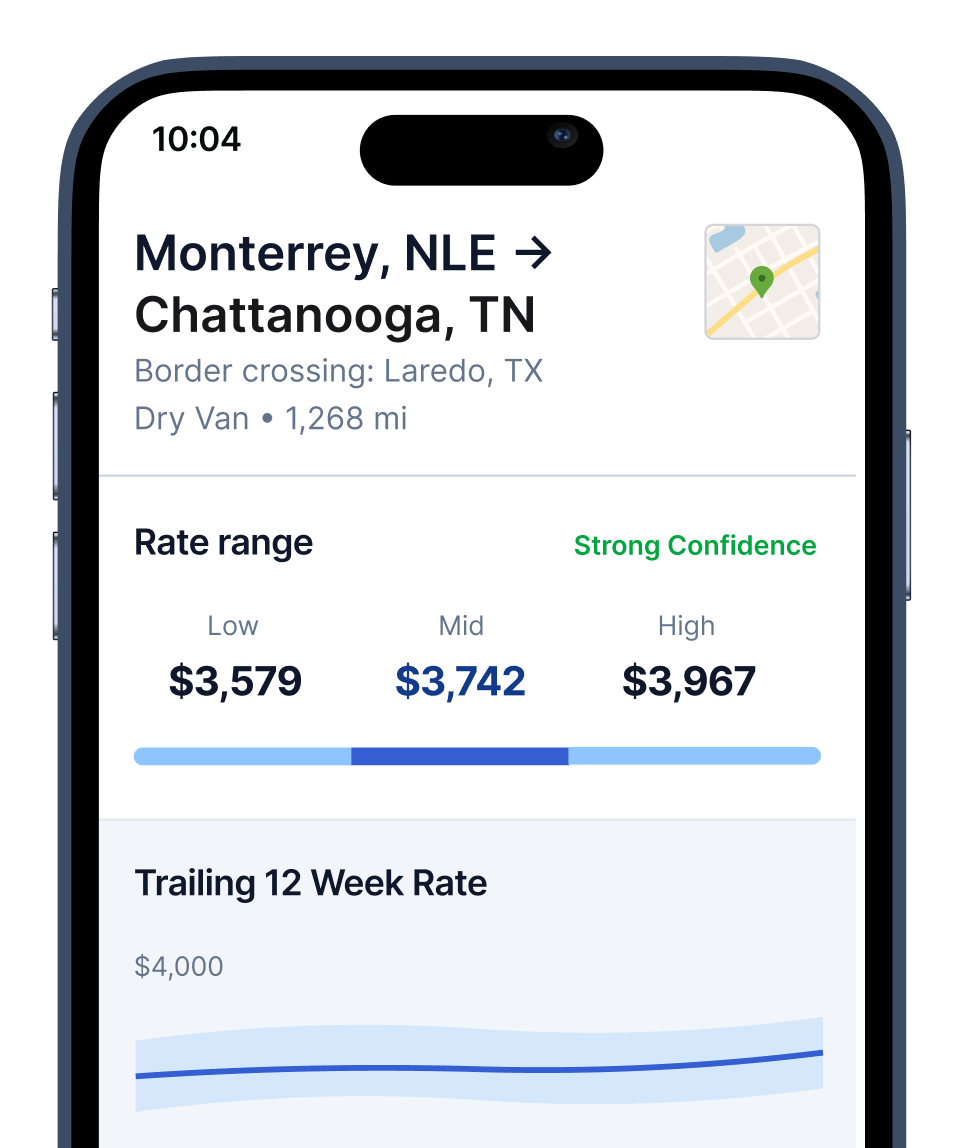
Cargado Market Rates: Monterrey to Chattanooga via Laredo, with Strong Confidence
See it on CargadoMy guess is you'll find you can cover far more of those loads than you'd expect. And the volume you win will make carriers more interested in working with you, which makes the next quote easier to commit to.
That's the same loop, just running the other way.
Then add another lane. Then another.
The real question
When you wait for a truck before you quote, what are you actually protecting yourself from?
P.S. If you've made the switch from truck-first to quoting first, I'd love to hear what it was like, including the loads that went sideways. Those stories are usually more useful than the wins.


