The SCOTUS broker ruling: more accountability, not doomsday
A broker-first take on what the Supreme Court actually said, why the internet is overreacting, and what to do next (without panicking).

The Supreme Court’s decision in Montgomery v. Caribe Transport II, LLC isn’t going to change what a truck is or how a load moves down the road. But it does put more attention and structure on carrier selection, monitoring, and documentation.
Not because it suddenly makes brokers “liable for everything.” It doesn’t.
But because it makes one thing unavoidable: carrier selection now has to be defensible.
If your operation has been built on informal workflows (phone calls, WhatsApp threads, tribal knowledge, and a thin paper trail), this decision raises the importance of tightening those workflows.
And I’ll say the quiet part plainly: the shadiest carriers are going to have a harder time getting freight. Good. If a carrier’s “edge” is hiding safety issues, swapping identities, or living in the gray, this ruling raises the cost of doing business. The industry should want that.
I’ve gotten this question enough times…
The Supreme Court just decided Montgomery v. Caribe Transport II, LLC (9–0), and you can already feel the freight internet doing what it always does: turning a nuanced decision into a one-sentence narrative.
“This crushes small brokers.” “Insurance goes 10x.” “Extinction event.”
I get why those takes spread. They’re simple, they’re dramatic, and they match the background anxiety a lot of people already feel about being in the middle of a transaction.
But it’s not the right mental model — and I don’t think this is a reason to panic.
This decision doesn’t make brokers “liable for everything.” It does something more practical: it makes carrier selection something you have to be able to explain like an adult. Not in a Slack thread. Not with a screenshot. Not with “trust me.” In a way that holds up when someone is asking questions months later.
And because of that, it changes behavior and process. Not overnight, and not universally — but enough that it’s worth taking seriously.
What the Court actually held (actually plain English)
Here’s the simplest way to understand it:
Before this decision, a lot of brokers tried to get these lawsuits thrown out fast by saying: “Federal law (FAAAA) blocks this kind of claim against a broker.”
The Supreme Court said: not when safety is the issue.
If a broker picks an unsafe carrier, and someone gets hurt, the injured person can sue the broker under state negligence law. The case doesn’t automatically get dismissed just because the broker is a broker.
Put differently:
You’re still not “liable for everything.”
But you may have to answer a basic question in court: “Why did you pick that carrier?”
That’s the shift. The fight moves from “you can’t sue me” to “did I act reasonably when I chose them?”
What this ruling does not mean
Let’s clear out the noise without pretending the risk isn’t real.
First: this is not strict liability. A broker is not automatically at fault because a carrier they used got into a crash. Plaintiffs still have to prove a real negligence case — duty, breach, and (crucially) causation. The fight moves from “you can’t sue me at all” to “did I act reasonably given what was knowable at the time?”
Second: this isn’t some new FMCSA rulebook that drops tomorrow. This is a litigation and accountability shift. It changes who gets named in lawsuits, what gets requested in discovery, and what an insurer or shipper will ask about your process.
Third: this doesn’t mean insurance instantly goes 10x. Pricing may move over time — especially if the market learns that some broker operations have basically no defensible selection process — but insurance doesn’t re-rate overnight because the internet decided a number.
What Kavanaugh signaled (and why it matters)
Justice Kavanaugh wrote a concurrence (joined by Alito). He agrees with the outcome, but he calls the case “closer” than the majority opinion suggests.
That matters because it’s basically a roadmap for how this plays out in real life. You should expect more lawsuits that name brokers, because preemption won’t automatically end the case early. But you shouldn’t interpret this as unlimited broker exposure either. The core fight becomes the messy, factual one: what did you do, what did you know, and was it reasonable?
That’s the right place for this to land. Because there’s a massive difference between selecting a carrier with obvious red flags that you ignored, and selecting a carrier that looked fine based on the information you had at the time.
What changes in the real world
Not everything. The world doesn’t flip overnight. But the center of gravity shifts.
The first change is that carrier selection documentation stops being a nice-to-have and starts being a first-class artifact. “We checked SAFER” won’t be the end of the conversation. The questions become: what did you check, when did you check it, what did you see, and why was your decision reasonable?
The second change is segmentation. In tight markets, everyone already prefers known-good capacity. This decision will reinforce that preference and make standards and exceptions more explicit.
And on the carrier side, I think it reinforces something overdue: there’s less room for theater. No more “strong solo Sergei” stories. No more having a buddy hop in a truck at a shipper just to prove there’s a team. When selection and safety get more scrutiny, carriers with real operations, real compliance, and real track record win more of the freight.
The third change is that tooling and workflow matter more than headcount. This is where I think the “small broker dies” story is wrong. Discipline is not a function of size — it’s a function of systems. If you can operationalize onboarding, checks, exceptions, and documentation in a repeatable way, you can run a tight operation at 10 seats or 1,000.
So does this crush small brokers?
Here’s the non-alarmist take:
This doesn’t crush small brokers. It crushes sloppy brokers.
People keep equating “small” with “non-compliant.” That’s lazy.
I’ve met plenty of small brokerages that are more disciplined than big ones.
What will get more expensive:
brokers who can’t prove what they did
brokers who routinely use carriers with visible red flags
brokers whose process is “cover at any cost”
That’s not a size problem. That’s a systems problem.
One more second-order effect I’m watching: this could accelerate broker consolidation. When risk goes up, scale has advantages — not because big is “smarter,” but because big can spread fixed costs (compliance, legal, insurance, safety tooling) across more volume. If you’re a big broker with a mature carrier approval program, buying a smaller shop with good customers but weak process starts to look attractive.
I don’t think this automatically turns into a wave of roll-ups. More likely, it’s a slow push: some smaller brokers will decide to invest in systems now, and some will decide to partner with someone who already has them.
What about small carriers?
Same framing.
Carriers aren’t winners or losers by size. The market will reward:
clean compliance
good safety posture
predictable execution
transparency
That’s good news for great small fleets.
The fleets that will feel pressure are the ones whose compliance story is messy — because “messy” is now more expensive to do business with.
Why this hits harder right now: the chaotic storm
This decision lands in a market that’s already stressed.
A few things are simultaneously true:
Capacity is tight and carriers are picky. In a carrier-driven market, brokers are already selling freight, not just posting it.
Mexico freight is structurally more complex — authority, border behavior, operational variance, and more scrutiny.
B1 / cabotage enforcement chatter is translating into real behavioral change. Whether every headline is accurate doesn’t matter as much as the fact that fleets are acting more cautiously. Phantom capacity disappears fast when enforcement tightens.
So the real story is not “SCOTUS alone changed everything.
The story is:
SCOTUS accelerates a shift that was already underway — toward defensible selection, stronger compliance posture, and more preference for known-good capacity — at the exact moment the market is already tight and cross-border is already noisy.
That’s why it feels like a shock wave.
Quick update: what I’m seeing a few days after the ruling
A few days later, the public conversation is starting to settle down.
The early “doomsday” takes are still floating around, but the most consistent theme I’m seeing from attorneys, industry publications, and trucking media is much more practical: tighten what you can control.
One signal worth noting: this is no longer just freight-Twitter discourse. It’s now being covered in more traditional trucking outlets as a “higher stakes for broker vetting” story. That means leadership teams across brokers and carriers will keep hearing about it, even if they never read a Supreme Court opinion.
The bigger second-order effect: why Chat + integrations are the future
When you zoom out, this ruling is about one thing: accountability.
Not accountability in the moral sense. Accountability in the operational sense:
Who selected the carrier?
Why?
What did they know?
What did they do?
What happened next?
The old freight workflow is basically built to erase that accountability:
phone calls
WhatsApp
forwarding PDFs
“ask Joe, he knows that carrier”
carrier packets in someone’s inbox
a TMS record that says “covered” but doesn’t say how
That model doesn’t scale. And under a higher-liability regime, it’s not just inefficient — it’s fragile.
This is also why this ruling can be a positive forcing function for the industry. Over the last few days, this has come up on nearly every broker call: leadership teams want a clear answer to “how do we control this risk?” The best answer isn’t panic. It’s moving to an operating model where quality is visible, standards are consistent, and the record is built automatically as you work.
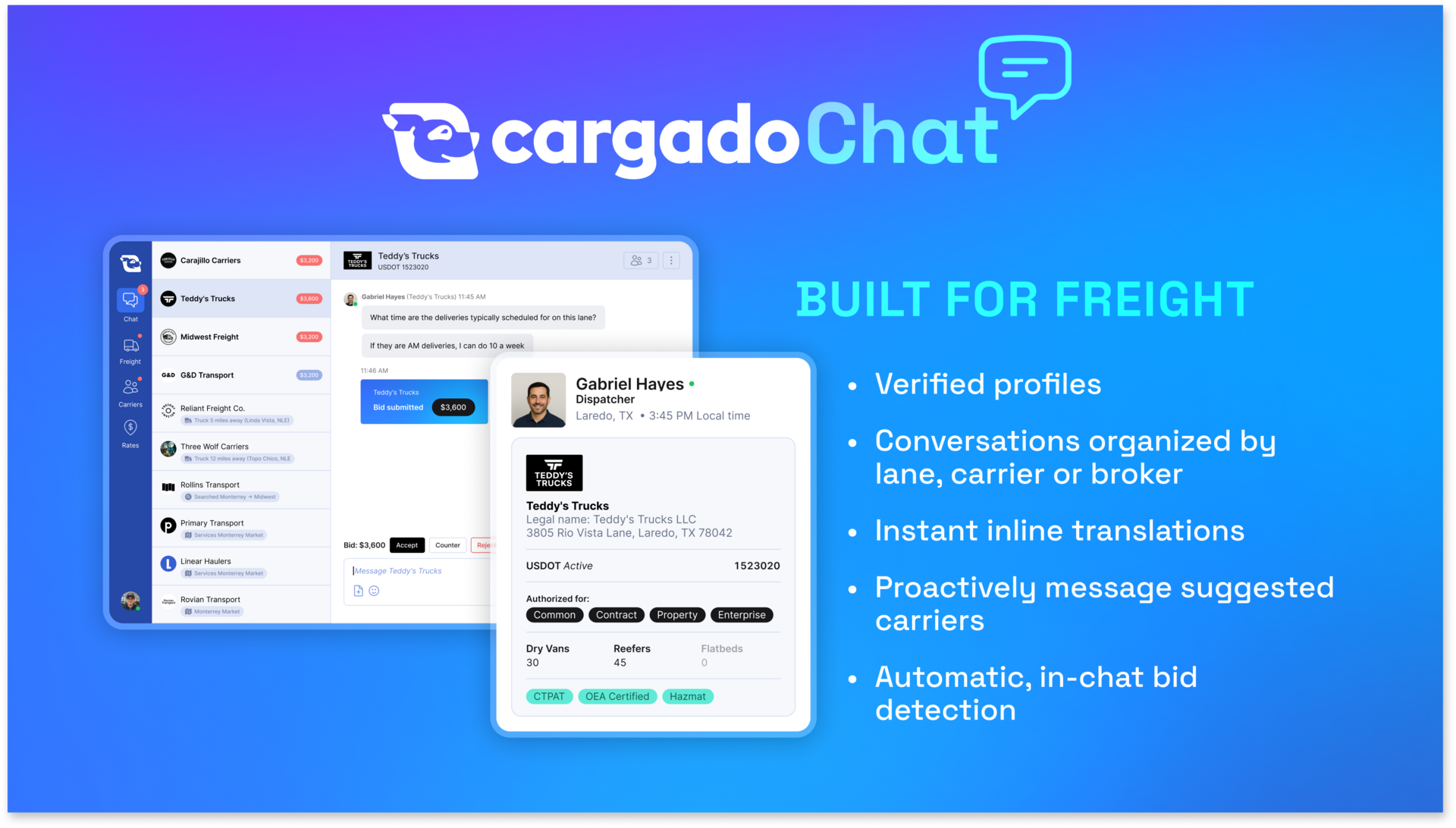
That’s exactly where a curated network and an integrated workflow shine. If you’re using a system that gives you vetted capacity, structured procurement, and auditable communication in one place, you’re not just reducing legal exposure. You’re building a better brokerage.
The future is the integrated workflow where:
the freight is posted once (or synced automatically)
the network responds with bids
the carrier selection process is visible
the broker-carrier conversation happens in the system
the “why” is defensible
and the output pushes back into the TMS
That’s not “nice to have.” It’s how you run a brokerage that’s built to last.
Why living in WhatsApp is risky (and why leadership has no oversight)
WhatsApp is great for speed. It’s terrible for running a real operation:
no structured context
no auditable record
no direct connection to bids / selection
no reliable handoff across a team
If your carrier conversations live in WhatsApp, you don’t actually have a carrier relationship asset. You have a set of private DMs.
And here’s the leadership problem: you can’t manage what you can’t see. When your execution lives in WhatsApp:
leadership can’t audit carrier selectio
compliance can’t enforce standards consistently
operations can’t coach the team off a bad habit
legal can’t reconstruct what happened without begging for screenshots
analytics can’t learn from outcomes because the data never enters the system
In a higher-liability world, “screenshots in a folder” is not a defensible operating model.
This is where network effects start compounding
The integrated model compounds because every interaction creates reusable data:
which carriers actually cover which lanes
how rates move over time
who responds fast
which communications lead to booked freight
where the process breaks
That data improves matching, improves pricing, improves coaching, improves carrier onboarding, improves the entire marketplace.
And it’s why the “one-off load board posting” model will look increasingly outdated.
A concrete example: 850-lane RFP out of El Paso (and why it matters)
Here’s the example I keep coming back to because it’s so clean:
850-lane RFP
out of El Paso (yes, domestic freight — it hits a border city)
and it resulted in 100% bid rate and multiple bids on most lanes
And the important part is the workflow:
it took one posting and an Excel file.
This is the shift:
not 850 separate phone trees
not 850 separate “rate check” scrambles
not 850 separate carrier packet requests
Just: post once, attach the sheet, let the network respond, and keep the full conversation + evidence trail tied to the freight.
That is exactly what the industry will move toward as selection becomes more scrutinized.
My “lean into it” take (the opportunity)
If you’re building in freight — as a broker, a shipper, or a platform — you have two options:
Option A: complain about the new risk
This is where most takes live. Fear, outrage, doom.
Option B: treat it like a forcing function
This is where the opportunity is.
Because if the market now demands:
a clearer carrier selection process
better visibility into safety signals
better documentation
fewer exceptions
cleaner execution…
Then the companies that build those muscles will win share.
Not because they’re bigger.
Because they’re better run.
Practical: what I’d do next week
If you’re a broker
Write down your minimum carrier standard (and stop hand-waving it).
Make exceptions explicit — and documented.
Treat vetting as a workflow, not a person.
Start building a preferred network that can cover your key lanes without panic.
Move as much communication as possible into systems that create a durable record.
If you’re a shipper
Expect brokers to ask for more process and data.
Align internally on what “safe enough” means (because that standard will surface in disputes).
Tighten routing guide governance — not for optics, for resilience.
If you’re a platform
Make safety + selection documentation a first-class feature.
Reduce compliance overhead so good behavior is the default.
Make Chat and collaboration part of the workflow, not a bolt-on.
Deepen integrations so the system of record stays consistent end-to-end.
Bottom line
This ruling increases litigation and scrutiny. It also rewards discipline.
It’s not the end of small brokers or small carriers.
It’s the end of pretending carrier selection doesn’t matter. The brokers and carriers that build a clean, defensible operating system (and the platforms that make that easy) will take shar